On Friday 28th May I started a three day road trip from Accra via Nwanta to Tamale. Abukari, my driver for the journey had come all the way from Tamale on Thursday, because renting a car in Tamale is still cheaper than in Accra. Otherwise I would have to send the car back to Accra at the end, because I would stay in Tamale for the week and fly back to Accra on Friday the 4th June. Abukari came exactly in time so that we could leave Accra at 06:00 sharp. I wanted to test how the connectivity was under way, so my idea was to use twitter to test that by sending photos and short messages during the entire trip. It worked better than I expected. I did sometimes have to wait for 15 minutes to reach the next tower, but in general I could submit my tweets when I wanted them to submit. So I could tweet live about the trip in an easy way. The road thru the Volta region was better than I remembered, although the part after Nkwanta was for the first part bad, but afterward especially after Damanko, the road was fine. For Abukari it was also an interesting experience, because he had never been in that part of his country. I have made a compilation video of the photos I twittered to my followers combined with local music of Ohemaa Mercy that you can watch here
maandag 31 mei 2010


Impressions of Barefootguide 2 writers workshop in Egmond
A short video to give an impression of the very inspiring week in Egmond with the Barefootguide 2 writers collective in Egmond from 17th - 21th May 2010
maandag 29 maart 2010
The creation of a new Barefootguide writers collective
 From 15th until 19th March I had a very inspiring writeshop in Kleinmond, South Africa. This was the start of a two 2 trajectory to create a new Barefootguide on organizational learning practices. With 10 participants from different countries it was a very divers group. There were 3 people from Holland: from PSO, Cordaid and IICD. 4 people from South Africa (3 from CDRA and 1 consultant), 1 person from Ghana (VSO), 1 from Belgium (but 15 year Zimbabwe, VVOB) and one New Zealander from The Red cross in Bangkok. The group had a 50% balance in gender as well. But most impressive were the experiences that everyone brought on the table working with southern NGOs and communities.
 The environment of the workshop
We were located 2 hours from Capetown in the small town of Kleinmond. We stayed in a holiday home in small bungalows in a beautiful, inspiring landscape with mountains in front of us and the Atlantic Ocean behind us. What better place could you have to start a writing collective. The idea was not to write just another guidebook, but to bring in the vast experiences of the participating NGO’s to bring theory and practice together in combination with an action research next year in 20 Southern NGO’s to bring the guide as a tool for transforming organizations and Social change into practice.
To develop this we needed to know each other much better, but also to develop our own writing voice. One of the exercises we used for this is the technique of freewriting. In freewriting your pen, rather than your mind decides what to write; the hand leads and the mind follows. As simple as it sounds, it’s no easy exercise and takes real discipline to stick to this simple premise. We did several exercises with a start sentence and 4 minutes of writing. Afterward you had to underline the key sentences and share this with a small group to make a poem out of it. That sounds a bit weird, but actually the poems were quit powerful.
learning insights
Another method that we used was it always powerful storytelling. With the freewriting exercises we also had described two of our key learning moments. You could share the stories with one of the others, pick one and shared that story with the whole group. During the whole week we told these stories and distilled the general lessons out of these stories to use that to describe inside-out how we have gone through our own learning journeys. These general insights were stored on colored papers on the whole: a big collection of thoughts at the end of the week.
To look outside-in to organisational learning the core group of the writers collective (PSO, VSO and CDRA) had done a literature review on organisational learning, which we discussed to see what was most inspirational, fascinating but also to define areas for deeper research, missing parts and remaining questions.
The leading image
 On day three we were on a quest for our vision. At 07.00 sharp we climbed in silence the mountain in front of were we stayed. At the top (a 30 minutes climb, through a beautiful landscape, one of the most diverse worldwide in terms of number of plans) we wrote our how we thought the Barefootguide would be used in the world in 5 years time as a free writing exercise. After a lovely walk down through a different path we brought all these stories together in small groups to design the leading image through a very creative drawing process. These three leading images were than shared and brought together into one picture with symbols, metaphors and key words.
The last day was the process that will lead to the development if the barefootguide. The next write workshop will be in May in Egmond (Netherlands). Before that time a needs assessment with some of the partners that will participate in the action research will take place (not at IICD partners) and a similar assessment about current learning practices should also be carried out under the organisations of the writers collective. In the next two weeks it will be more clear what that will mean for IICD. The action research for next year was also designed, but the key question for the next two year were the research areas which needed more deeper research. Also adding the voice of the south more. All of uMood paintingss will contribute more case studies like our thematic learning briefs, our Learn-Work trajectory and country learning reports. We concluded with a mood image of the whole week which was again an creative exercise to trigger your right brain. All in all a very inspirational, intensive and challenging workshop. Looking forward to continue this process in May.
vrijdag 20 november 2009
“ICT & Education, a look at the Computerised Schools Selection and Placement System (CSSPS)”
Monday morning 09.00. GINKS is organising a seminar on “ICT & Education, a look at the Computerised Schools Selection and Placement System (CSSPS)”. Not many people have yet arrived, but at 09.45 we can start with the seminar with around 35 participants
In the panel are 4 people from a different background with Mr. Edward Addo-Dankwa, as the moderator for the forum (and a board member of GINKS). The panel consist of Mr. J.J.K. Baku, the DR/Head of the WAEC Research department, Madam Victoria Opoku, the Director of Secondary Education Division at the Ghana Education Service (GES), Mr. Samuel Ofori-Adjei, the headmaster of Accra academy, who is also CHASS president and Bridgit Sloan McMullen, Uniterra/WUSC volunteer on behalf of Child’s Rights International.

The most interesting part of the whole discussion was the insight in the difficulties of the Ghanaian School system. A system that is really different from the Dutch system. After Junior Highschool all Ghanaian school kids do a test: the BECE test. This test is the most important test for the future of most Ghanaian kids. It will determine if you are aloud to continue with your school and can go to Senior Highschool, but it will also determine the quality of the school you can go to.

If you have a score of more than 30 points you are not allowed to go to senior secondary school. But even with less than 30 points you are not sure of a placement, because there are not enough places in senior secondary schools. Last year 68,000 children were not placed, while 147,000 did found a placement. Ghanaian people also favour boarding schools over day schools.

Every kid can make a choice of 6 schools and these can be all over the country. The new CSSPS system makes than a selection, based on the number of points you have. So the choice you make in these 6 schools is very important. If you pick 6 top schools, but you have not a very low score, than you have the chance that no school have selected you. Than you have to wait if there are still vacancies afterwards after all selections have been made, to see if you can still be placed. But if you choose schools in different leves, you make a better chance.
This is how it works. If there are for example 100 places for a school at level 1, it will select the 100 best students who selected this school as there number 1. Maybe the cut off for this school is 9 points. If you have 15 points the system will than look at your second choice. It will look if there are in there selected list people with more than 15 points. If that is the case, you are selected. Otherwise it will look at your third choice. Etc until your sixth choice.
The system only looks at merits, with is a big advantage to the old system, that had a lot of corruption and favouring in it. But there were also disadvantages. The panel plead for the introduction raw scores (the percentage that you score for a subject) in stead of just the aggregate number. The other critic was about the online announcement that favours urban people. Although everyone receive the result per mail, some have earlier access, because the online announcement. The system has shown that smart kids from rural areas have now the opportunity to go to top schools, which was almost impossible in the old system without the right connections. But a question mark was there also to see if this was in the best interest of the child!
In the panel are 4 people from a different background with Mr. Edward Addo-Dankwa, as the moderator for the forum (and a board member of GINKS). The panel consist of Mr. J.J.K. Baku, the DR/Head of the WAEC Research department, Madam Victoria Opoku, the Director of Secondary Education Division at the Ghana Education Service (GES), Mr. Samuel Ofori-Adjei, the headmaster of Accra academy, who is also CHASS president and Bridgit Sloan McMullen, Uniterra/WUSC volunteer on behalf of Child’s Rights International.
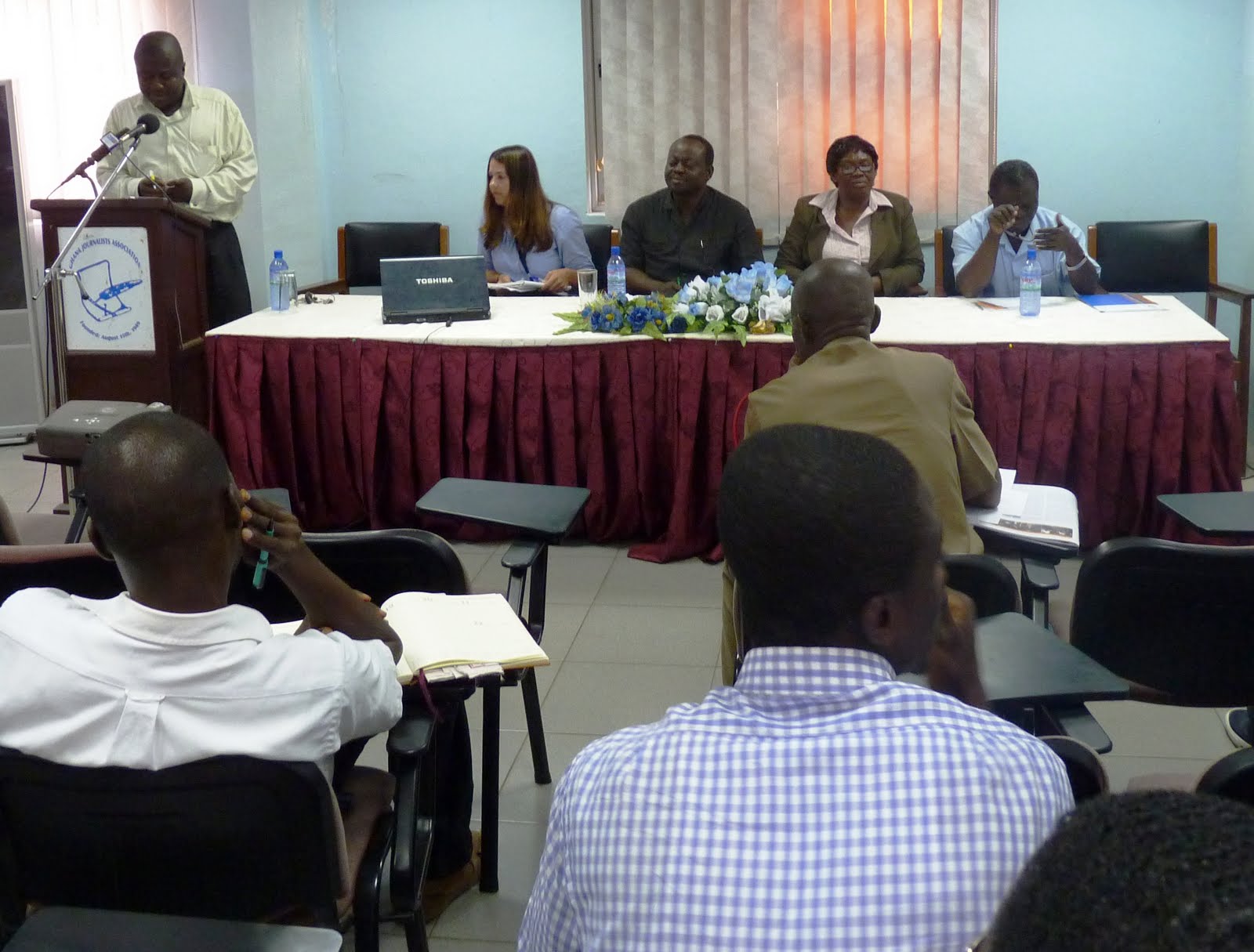
The most interesting part of the whole discussion was the insight in the difficulties of the Ghanaian School system. A system that is really different from the Dutch system. After Junior Highschool all Ghanaian school kids do a test: the BECE test. This test is the most important test for the future of most Ghanaian kids. It will determine if you are aloud to continue with your school and can go to Senior Highschool, but it will also determine the quality of the school you can go to.

If you have a score of more than 30 points you are not allowed to go to senior secondary school. But even with less than 30 points you are not sure of a placement, because there are not enough places in senior secondary schools. Last year 68,000 children were not placed, while 147,000 did found a placement. Ghanaian people also favour boarding schools over day schools.

Every kid can make a choice of 6 schools and these can be all over the country. The new CSSPS system makes than a selection, based on the number of points you have. So the choice you make in these 6 schools is very important. If you pick 6 top schools, but you have not a very low score, than you have the chance that no school have selected you. Than you have to wait if there are still vacancies afterwards after all selections have been made, to see if you can still be placed. But if you choose schools in different leves, you make a better chance.
This is how it works. If there are for example 100 places for a school at level 1, it will select the 100 best students who selected this school as there number 1. Maybe the cut off for this school is 9 points. If you have 15 points the system will than look at your second choice. It will look if there are in there selected list people with more than 15 points. If that is the case, you are selected. Otherwise it will look at your third choice. Etc until your sixth choice.
The system only looks at merits, with is a big advantage to the old system, that had a lot of corruption and favouring in it. But there were also disadvantages. The panel plead for the introduction raw scores (the percentage that you score for a subject) in stead of just the aggregate number. The other critic was about the online announcement that favours urban people. Although everyone receive the result per mail, some have earlier access, because the online announcement. The system has shown that smart kids from rural areas have now the opportunity to go to top schools, which was almost impossible in the old system without the right connections. But a question mark was there also to see if this was in the best interest of the child!
dinsdag 15 september 2009
woensdag 9 september 2009
Solar Chargers for Farming Cooperatives in Ghana
Davy, from SEND foundation, would pick me up on Saturday morning 1st August at 06.00 and he was there on the dot. In clean white he thought that we would only go to Salaga to visit  the field office. You could see the flooding along the road. In Salaga we picked up Wumpini, the senior officer of SEND at Salaga, to visit three farmer communities who tested a solar charger for mobile phones in the ECAMIC project. In February A-Solar, a Dutch company, donated 5 solar chargers to test in Ghana in 5 farmer groups.
ECAMIC is a project where farmers have access to market information through a mixture of channels: notice boards, field staff and mobile phone. All these communities have no access to electricity, although in one community the electricity cable was passing the village! The first community was a very big community with 700 families. 25 of them participated in the SEND farm cooperative. The ECAMIC project provided them with 2 subsidized phones, but now already 20 of them have phones. Mobile phones are booming in the Kalende community, but there is no electricity. No one else has solar power and there are no phone shops where they can buy credits. They are 6 km from Salaga, where everything is available, but that consumes a lot of time and commercial charging is expensive. The solar charger was a huge success. But it was not enough to even charge the phones in the group. With sunny weather the charger could charge 3 phones a day, with clouds only 2.
They would like to charge 30 a day. Now they have seen the advantages of phones all of them would like to have one. They not only use it for accessing market information, but all their crops (yams, maize, ground nuts, vegetables, etc) are in the system. If market traders visit the village they have a better negotiating position. They also have contact with market traders in Accra and Kumasi by phone.
The phone is also used to contact people in Salaga to bring goods if they will come to the village or to contact relatives in case of a funeral. The other two communities were smaller. Sogon 1 and Bondando had groups of 20 farm families. In both groups there were 8 phones. They both would like to be able to charge 6 phones a day and more phones for the group for a subsidized rate. All three groups would like to set up a small shop to charge mobiles. They would also charge other phones in the community for a small fee for the benefit of the cooperative, though the small chargers more are meant for personal use than for commercial use. But all have seen the benefits of the mobile phone and the impact it can make on their lives.
 the field office. You could see the flooding along the road. In Salaga we picked up Wumpini, the senior officer of SEND at Salaga, to visit three farmer communities who tested a solar charger for mobile phones in the ECAMIC project. In February A-Solar, a Dutch company, donated 5 solar chargers to test in Ghana in 5 farmer groups.
ECAMIC is a project where farmers have access to market information through a mixture of channels: notice boards, field staff and mobile phone. All these communities have no access to electricity, although in one community the electricity cable was passing the village! The first community was a very big community with 700
 families. 25 of them participated in the SEND farm cooperative. The ECAMIC project provided them with 2 subsidized phones, but now already 20 of them have phones. Mobile phones are booming in the Kalende community, but there is no electricity. No one else has solar power and there are no phone shops where they can buy credits. They are 6 km from Salaga, where everything is available, but that consumes a lot of time and commercial charging is expensive. The solar charger was a huge success. But it was not enough to even charge the phones in the group. With sunny weather the charger could charge 3 phones a day, with clouds only 2.
They would like to charge 30 a day. Now they have seen the advantages of phones all of them would like to have one. They not only use it for
 accessing market information, but all their crops (yams, maize, ground nuts, vegetables, etc) are in the system. If market traders visit the village they have a better negotiating position. They also have contact with market traders in Accra and Kumasi by phone.
The phone is also used to contact people in Salaga to bring goods if they will come to the village or to contact relatives in case of a funeral. The other two communities were smaller. Sogon 1 and Bondando had groups of 20 farm families. In both groups there were 8 phones. They both would like to be able to charge 6 phones a day and more phones for the group for a subsidized rate. All three groups would like to set up a small shop to charge mobiles. They would also charge other phones in the community for a small fee for the benefit of the cooperative, though the small chargers more are meant for personal use than for commercial use. But all have seen the benefits of the mobile phone and the impact it can make on their lives.
Abonneren op:
Posts (Atom)