In Kaoma we would meet at the bank. Clearly there was only one bank in Kaoma, so it was easy to find. I met Jonathan Mugandi and Justin Lunda and together we had a meeting at the Maranatha Grassroot Institute (MGI), a local NGO that helps to implement the bee keeping programme. The Beekeeping project is funded by the EU thru HIVOS, OPPAZ and MGI. It supports 500 families in rural villages (closest 50 km from Kaoma, which is also not a really big rural town) with 2000 bee hives. They work with modern bee hives, which are better for the environment that the tradional one, that was build on cut trees. And in the modern beehives, you do have a more consistent, better quality honey as well and it makes harvesting easier, so that more women are involved in the project, than would be possible with tradional beekeeping.
The families would get 4 beehives, protective cloth, processing equipment and capacity building to make it happen. The beehives are not given to them. They have given a revolving loan and pay back after there first harvest. They pay back in 4 seasons, to create already income from the first harvest.
The beekeepers want to promote organic honey and get international certificates. In July they will start with the OPPAZ Internal Control System, that will shorten the certification process, because records will be electronically and not on paper. This makes exchange between internal and external inspectors easier and shorten the time required for certification.
The beekeepers already started with the forms, that will be used for electronical entry on a quarterly base. This gives them more work, but helps them with proper record keeping. They have one laptop and one desktop, with internet access thru ZAIN GPRS modem. They have trained themselves, but will receive more training thru OPPAZ later. They are looking forward to this.
donderdag 29 juli 2010


woensdag 28 juli 2010
Zorga, Organic Rice farmers in Mongu District

On the 4th of May I started of to Zorga, the organic rice farmers in Mongu. They are a member of one of our partners the Organic Producers and Processors Association of Zambia (OPPAZ). I thought there office was in Mongu, but when I called again it was 15 km further in Sefula on the road to Senanga. After 6 calls where they explained me where to turn off based on my description of where I was, I managed to find them. I had a meeting with Chedrick, the chairperson; Nawa, the vice-chair; Munalula, the accountant and Yembe a committee member.
As organic rice farmers they have a major challenge: the market! The is not really a local market for organic rice. People are poor and what the cheapest food possible. Rice is not the staple food, that is Nshima (made from maize meal), so it is already a bit of luxury to spend money on rice. But the conventional rice is cheaper, because of subsidized fertilizer. So they can sell it locally, but for the same cheap price, while the organic rice gives a lower yield. There is a market for them in South Africa. But than you need to transport it in a container. To maximize the utilization of the container you need to transport 30 ton, but they only produce with all 74 members 8 ton. So they need more members to create a market, but without the access to this market no one want to start organic rice. Kind of a deadlock!
The other challenge is a lack of implements that would improve their yield in the field.
As an association they use computers for accounts, minutes of meetings and to write reports. There is no internet access, but the accountant is based in Mongu, and he can access internet and the Zorga e-mail account.
As organic farmers they need to be internationally recognized, therefore you need to be certified. This is still a completely manual process, but some of the members are trained in the use of the Oppaz Internal Control System the IICD supported. This ICS makes it easier to get internationally certified, because the information becomes digital available for both internal inspectors and external inspectors. This shortens the total time before a farmer is certified. But without the market this still does not improve the quality of live for the farmers, who are struggling. Oppaz want to help them further by building their market access capacity further, so that they are better able to access the right information and the right markets. This would provides them with better incomes and more benefits, which will attract more farmers to move from conventional rice farming with pesticides and fertilizer to organic, more natural farming.
dinsdag 13 juli 2010
maandag 31 mei 2010
Road trip Accra (Ghana) - Nkwanta - Tamale for IICD
On Friday 28th May I started a three day road trip from Accra via Nwanta to Tamale. Abukari, my driver for the journey had come all the way from Tamale on Thursday, because renting a car in Tamale is still cheaper than in Accra. Otherwise I would have to send the car back to Accra at the end, because I would stay in Tamale for the week and fly back to Accra on Friday the 4th June. Abukari came exactly in time so that we could leave Accra at 06:00 sharp. I wanted to test how the connectivity was under way, so my idea was to use twitter to test that by sending photos and short messages during the entire trip. It worked better than I expected. I did sometimes have to wait for 15 minutes to reach the next tower, but in general I could submit my tweets when I wanted them to submit. So I could tweet live about the trip in an easy way. The road thru the Volta region was better than I remembered, although the part after Nkwanta was for the first part bad, but afterward especially after Damanko, the road was fine. For Abukari it was also an interesting experience, because he had never been in that part of his country. I have made a compilation video of the photos I twittered to my followers combined with local music of Ohemaa Mercy that you can watch here
Impressions of Barefootguide 2 writers workshop in Egmond
A short video to give an impression of the very inspiring week in Egmond with the Barefootguide 2 writers collective in Egmond from 17th - 21th May 2010
maandag 29 maart 2010
The creation of a new Barefootguide writers collective
 From 15th until 19th March I had a very inspiring writeshop in Kleinmond, South Africa. This was the start of a two 2 trajectory to create a new Barefootguide on organizational learning practices. With 10 participants from different countries it was a very divers group. There were 3 people from Holland: from PSO, Cordaid and IICD. 4 people from South Africa (3 from CDRA and 1 consultant), 1 person from Ghana (VSO), 1 from Belgium (but 15 year Zimbabwe, VVOB) and one New Zealander from The Red cross in Bangkok. The group had a 50% balance in gender as well. But most impressive were the experiences that everyone brought on the table working with southern NGOs and communities.
 The environment of the workshop
We were located 2 hours from Capetown in the small town of Kleinmond. We stayed in a holiday home in small bungalows in a beautiful, inspiring landscape with mountains in front of us and the Atlantic Ocean behind us. What better place could you have to start a writing collective. The idea was not to write just another guidebook, but to bring in the vast experiences of the participating NGO’s to bring theory and practice together in combination with an action research next year in 20 Southern NGO’s to bring the guide as a tool for transforming organizations and Social change into practice.
To develop this we needed to know each other much better, but also to develop our own writing voice. One of the exercises we used for this is the technique of freewriting. In freewriting your pen, rather than your mind decides what to write; the hand leads and the mind follows. As simple as it sounds, it’s no easy exercise and takes real discipline to stick to this simple premise. We did several exercises with a start sentence and 4 minutes of writing. Afterward you had to underline the key sentences and share this with a small group to make a poem out of it. That sounds a bit weird, but actually the poems were quit powerful.
learning insights
Another method that we used was it always powerful storytelling. With the freewriting exercises we also had described two of our key learning moments. You could share the stories with one of the others, pick one and shared that story with the whole group. During the whole week we told these stories and distilled the general lessons out of these stories to use that to describe inside-out how we have gone through our own learning journeys. These general insights were stored on colored papers on the whole: a big collection of thoughts at the end of the week.
To look outside-in to organisational learning the core group of the writers collective (PSO, VSO and CDRA) had done a literature review on organisational learning, which we discussed to see what was most inspirational, fascinating but also to define areas for deeper research, missing parts and remaining questions.
The leading image
 On day three we were on a quest for our vision. At 07.00 sharp we climbed in silence the mountain in front of were we stayed. At the top (a 30 minutes climb, through a beautiful landscape, one of the most diverse worldwide in terms of number of plans) we wrote our how we thought the Barefootguide would be used in the world in 5 years time as a free writing exercise. After a lovely walk down through a different path we brought all these stories together in small groups to design the leading image through a very creative drawing process. These three leading images were than shared and brought together into one picture with symbols, metaphors and key words.
The last day was the process that will lead to the development if the barefootguide. The next write workshop will be in May in Egmond (Netherlands). Before that time a needs assessment with some of the partners that will participate in the action research will take place (not at IICD partners) and a similar assessment about current learning practices should also be carried out under the organisations of the writers collective. In the next two weeks it will be more clear what that will mean for IICD. The action research for next year was also designed, but the key question for the next two year were the research areas which needed more deeper research. Also adding the voice of the south more. All of uMood paintingss will contribute more case studies like our thematic learning briefs, our Learn-Work trajectory and country learning reports. We concluded with a mood image of the whole week which was again an creative exercise to trigger your right brain. All in all a very inspirational, intensive and challenging workshop. Looking forward to continue this process in May.
vrijdag 20 november 2009
“ICT & Education, a look at the Computerised Schools Selection and Placement System (CSSPS)”
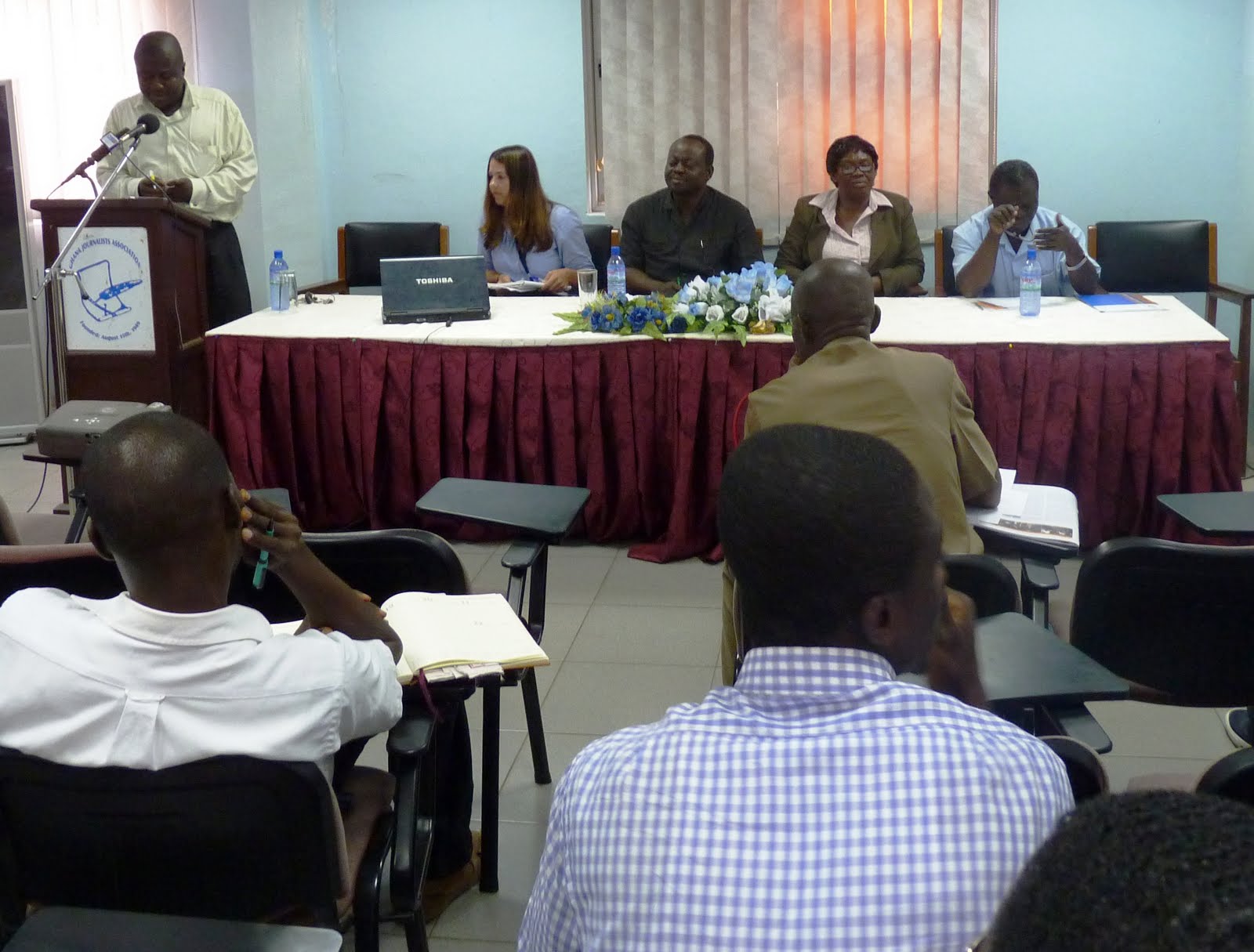
Monday morning 09.00. GINKS is organising a seminar on “ICT & Education, a look at the Computerised Schools Selection and Placement System (CSSPS)”. Not many people have yet arrived, but at 09.45 we can start with the seminar with around 35 participants
In the panel are 4 people from a different background with Mr. Edward Addo-Dankwa, as the moderator for the forum (and a board member of GINKS). The panel consist of Mr. J.J.K. Baku, the DR/Head of the WAEC Research department, Madam Victoria Opoku, the Director of Secondary Education Division at the Ghana Education Service (GES), Mr. Samuel Ofori-Adjei, the headmaster of Accra academy, who is also CHASS president and Bridgit Sloan McMullen, Uniterra/WUSC volunteer on behalf of Child’s Rights International.

The most interesting part of the whole discussion was the insight in the difficulties of the Ghanaian School system. A system that is really different from the Dutch system. After Junior Highschool all Ghanaian school kids do a test: the BECE test. This test is the most important test for the future of most Ghanaian kids. It will determine if you are aloud to continue with your school and can go to Senior Highschool, but it will also determine the quality of the school you can go to.

If you have a score of more than 30 points you are not allowed to go to senior secondary school. But even with less than 30 points you are not sure of a placement, because there are not enough places in senior secondary schools. Last year 68,000 children were not placed, while 147,000 did found a placement. Ghanaian people also favour boarding schools over day schools.

Every kid can make a choice of 6 schools and these can be all over the country. The new CSSPS system makes than a selection, based on the number of points you have. So the choice you make in these 6 schools is very important. If you pick 6 top schools, but you have not a very low score, than you have the chance that no school have selected you. Than you have to wait if there are still vacancies afterwards after all selections have been made, to see if you can still be placed. But if you choose schools in different leves, you make a better chance.
This is how it works. If there are for example 100 places for a school at level 1, it will select the 100 best students who selected this school as there number 1. Maybe the cut off for this school is 9 points. If you have 15 points the system will than look at your second choice. It will look if there are in there selected list people with more than 15 points. If that is the case, you are selected. Otherwise it will look at your third choice. Etc until your sixth choice.
The system only looks at merits, with is a big advantage to the old system, that had a lot of corruption and favouring in it. But there were also disadvantages. The panel plead for the introduction raw scores (the percentage that you score for a subject) in stead of just the aggregate number. The other critic was about the online announcement that favours urban people. Although everyone receive the result per mail, some have earlier access, because the online announcement. The system has shown that smart kids from rural areas have now the opportunity to go to top schools, which was almost impossible in the old system without the right connections. But a question mark was there also to see if this was in the best interest of the child!
In the panel are 4 people from a different background with Mr. Edward Addo-Dankwa, as the moderator for the forum (and a board member of GINKS). The panel consist of Mr. J.J.K. Baku, the DR/Head of the WAEC Research department, Madam Victoria Opoku, the Director of Secondary Education Division at the Ghana Education Service (GES), Mr. Samuel Ofori-Adjei, the headmaster of Accra academy, who is also CHASS president and Bridgit Sloan McMullen, Uniterra/WUSC volunteer on behalf of Child’s Rights International.
The most interesting part of the whole discussion was the insight in the difficulties of the Ghanaian School system. A system that is really different from the Dutch system. After Junior Highschool all Ghanaian school kids do a test: the BECE test. This test is the most important test for the future of most Ghanaian kids. It will determine if you are aloud to continue with your school and can go to Senior Highschool, but it will also determine the quality of the school you can go to.

If you have a score of more than 30 points you are not allowed to go to senior secondary school. But even with less than 30 points you are not sure of a placement, because there are not enough places in senior secondary schools. Last year 68,000 children were not placed, while 147,000 did found a placement. Ghanaian people also favour boarding schools over day schools.

Every kid can make a choice of 6 schools and these can be all over the country. The new CSSPS system makes than a selection, based on the number of points you have. So the choice you make in these 6 schools is very important. If you pick 6 top schools, but you have not a very low score, than you have the chance that no school have selected you. Than you have to wait if there are still vacancies afterwards after all selections have been made, to see if you can still be placed. But if you choose schools in different leves, you make a better chance.
This is how it works. If there are for example 100 places for a school at level 1, it will select the 100 best students who selected this school as there number 1. Maybe the cut off for this school is 9 points. If you have 15 points the system will than look at your second choice. It will look if there are in there selected list people with more than 15 points. If that is the case, you are selected. Otherwise it will look at your third choice. Etc until your sixth choice.
The system only looks at merits, with is a big advantage to the old system, that had a lot of corruption and favouring in it. But there were also disadvantages. The panel plead for the introduction raw scores (the percentage that you score for a subject) in stead of just the aggregate number. The other critic was about the online announcement that favours urban people. Although everyone receive the result per mail, some have earlier access, because the online announcement. The system has shown that smart kids from rural areas have now the opportunity to go to top schools, which was almost impossible in the old system without the right connections. But a question mark was there also to see if this was in the best interest of the child!
Abonneren op:
Posts (Atom)